
French Tech 2026: An Ecosystem Ready to Compete on the Global Stage

Bangkok, Thailand
Co-president
La French Tech Bangkok

18,000 active startups, 450,000 direct jobs, and €4.9 billion raised in the first half of 2026. France’s technology ecosystem is growing in scale, attracting international capital and turning scientific innovation into industrial opportunities. The latest French Tech overview shows how the ecosystem is positioning itself for its next stage of development and why its international network matters.
A technology ecosystem coming of age
The 2026 edition of the Overview of the French Tech Ecosystem sends a clear message: French Tech has reached a new stage in its development. What began as a movement to support French technology startups has become a substantial economic force, with ambitions extending well beyond France’s borders.
The figures tell part of the story. France counts 18,000 active startups, generating 450,000 direct jobs. In the first half of 2026 alone, these companies raised €4.9 billion, a 77% increase compared with the same period in 2025.
These results reflect more than the growth of individual companies. They point to an ecosystem that is increasingly capable of financing ambitious projects, developing breakthrough technologies, and bringing innovation into established industries.
The report also highlights a shift in investor expectations. Rather than simply backing a large number of early-stage ventures, investors are increasingly directing capital towards companies with the potential to scale rapidly and compete internationally. Larger funding rounds are becoming an important part of this transition.
For France, the objective is clear: build globally competitive technology companies that contribute to economic growth, industrial competitiveness, and technological sovereignty.
For entrepreneurs, investors, and corporate leaders, the 2026 overview offers a useful picture of where French Tech stands today and where opportunities are emerging.
1. Startups are becoming a major economic driver.
The French Tech ecosystem continues to demonstrate its importance to the French economy, particularly through employment.
According to the report, startup employment increased by 5% in the first half of 2026, based on a like-for-like sample of approximately 8,000 startups monitored monthly. Growth was recorded across every French region, despite the economic headwinds facing businesses.
The distribution of new jobs, however, remains uneven. The Île-de-France region, which includes Paris, accounted for approximately 70% of new startup jobs during the period. At the same time, regions such as Nouvelle-Aquitaine and Auvergne-Rhône-Alpes are showing positive momentum.
This combination of a strong Parisian hub and increasingly active regional ecosystems is an important feature of French Tech. Innovation is not confined to the capital. Different regions are developing their own areas of expertise, supported by local research institutions, entrepreneurs, investors, and industrial partners.
The sector breakdown also reveals how technology companies are responding to major economic and societal challenges.
Software remains the largest sector, accounting for approximately 121,000 jobs. Meanwhile, greentech employs 51,030 people, following 4.9% growth compared with 2025. Healthcare accounts for 37,310 jobs, with employment increasing by 5.3%.
These sectors illustrate the breadth of the ecosystem. Software continues to provide the digital foundations for businesses and consumers, while greentech and healthcare are developing solutions to challenges that extend far beyond France.
For international companies looking for technology partners, this diversity matters. French Tech is not a single industry or a collection of consumer applications. It encompasses software, industrial technologies, healthcare, climate solutions, and advanced scientific research.
2. Funding is shifting towards ambition and scale.
The report's fundraising figures are among its most striking findings.
French startups raised €4.9 billion in the first half of 2026, compared with €2.8 billion during the same period in 2025. This represents an increase of 77% in one year.
France remains the third-largest European ecosystem for fundraising, behind the United Kingdom and Germany. Yet the report highlights another significant measure: the average deal size reached €23.2 million, placing France at the top of the European ranking on this indicator.
The distinction between the number of transactions and the amount invested is important. A growing ecosystem does not necessarily need to produce ever more funding rounds. It also needs companies capable of attracting substantial investment as they move towards international expansion.
The report identifies precisely this trend. Amounts raised through Series C, D, and E rounds nearly tripled over one year, indicating greater investor appetite for later-stage businesses with the potential to become global leaders.
This does not mean early-stage funding has become irrelevant. Pre-seed, seed, and Series A investments remain essential to developing new technologies and bringing ideas to market. However, the growing importance of later-stage financing points to a more mature ecosystem, in which investors are backing companies with larger ambitions and the potential to operate at international scale.
For founders, this creates both opportunities and expectations. Access to significant funding can accelerate product development, recruitment, and market expansion. In return, companies must demonstrate that their business models, leadership teams, and operating structures can support that growth.
For international investors, France offers a combination of scientific capabilities, entrepreneurial talent and companies seeking capital to expand beyond their domestic market.
3. Innovation moves from the laboratory into industry.
The second major theme of the report is the relationship between scientific research, breakthrough technologies, and industrial development.
France has invested in research capabilities over many years. The challenge now is to translate that scientific foundation into commercially viable products, competitive businesses, and technologies that strengthen European technological sovereignty.
Several fields stand out.
Artificial intelligence: a rapidly expanding ecosystem
Artificial intelligence has become a central component of French Tech.
The report records 2,244 AI startups in 2026, up from 1,917 in 2025. These companies employ 55,045 people and raised €1.566 billion during the period covered by the report.
The development of AI in France is supported by the convergence of research, technical talent, entrepreneurial activity, and investment. Companies such as Mistral AI illustrate the international ambitions of this ecosystem.
The opportunity extends well beyond the creation of AI models. AI is increasingly relevant to enterprise software, customer service, industrial processes, data analysis, and the automation of complex workflows.
For businesses, the commercial question is how these capabilities can be translated into measurable improvements in productivity, decision-making, and customer experience.
Deeptech and technological sovereignty
Deeptech occupies a particularly important place in the French innovation landscape.
These companies turn advances in scientific research into industrial applications, with potential uses ranging from healthcare to security. The report identifies deeptech as a strategic lever for technological sovereignty and European competitiveness.
Its importance is also reflected in the French Tech Next40/120 programme: deeptech companies account for 38% of the 2026 cohort.
The significance of deeptech lies in its potential to address areas where technological capabilities have direct economic or strategic consequences. Developing these technologies requires substantial research, specialist talent, patient capital and close cooperation between laboratories, startups and industrial partners.
Commercialisation can take time, but the resulting innovations may create entirely new markets or transform established industries.
Robotics and quantum computing
French robotics companies are developing solutions ranging from modular systems to humanoid robotics and AI-powered automation.
As businesses face pressure to improve productivity and adapt their operations, robotics can support more flexible manufacturing, automate repetitive tasks, and address increasingly complex industrial requirements.
Quantum computing represents another area of long-term investment. French startups are working on technologies related to high-performance computing, post-quantum cryptography, and ultra-precise sensors.
Although many applications remain at an early stage, these developments could have implications for security, finance, healthcare, and other sectors that rely on advanced computing capabilities.
Space, greentech, and healthcare
France's space ecosystem builds on established expertise in launchers, satellites, and space technologies. New companies are expanding across the value chain, including connectivity, Earth observation, and security solutions. Together, these activities contribute to France's position in the European New Space sector.
Greentech has also become a central pillar of the ecosystem. Startups are developing solutions to decarbonise industry, transform agriculture, and use resources more efficiently. Their work connects environmental objectives with industrial competitiveness, sustainable production, and the circular economy.
Healthcare offers another example of research translating into practical applications. French startups are advancing diagnostics and therapies while building on the country's scientific and pharmaceutical expertise. Regional hubs, including Auvergne-Rhône-Alpes, are contributing to this development.
Taken together, these sectors show how French Tech is extending beyond digital services into technologies that can reshape industry, infrastructure and essential services.
4. Regional innovation is gaining ground.
Although Paris remains the leading hub for investment and startup activity, the report makes clear that French innovation is not concentrated in a single city.
Every French region has companies developing technologies with national and international ambitions. Regional ecosystems benefit from specialist industrial clusters, universities, research centers, and established businesses that can provide expertise, infrastructure, and commercial opportunities.
This diversity is particularly visible in deeptech, healthcare, greentech, industrial technology, and space.
Regional fundraising activity also points to new centers of momentum. Auvergne-Rhône-Alpes and Occitanie, for example, recorded strong developments in 2026, supported in part by deeptech activity.
For international partners, this creates opportunities to look beyond the best-known French technology companies and discover specialist businesses with expertise in particular markets or technologies.
It also reinforces the importance of connections between regions. A startup's ability to access research, investment, industrial partners, and international customers may depend on relationships that extend well beyond its home city.
5. Corporates and startups are working more closely together.
The report identifies a significant increase in cooperation between French startups and major corporations.
Relationships between CAC 40 companies and French startups have increased 3.5-fold since 2023.
This is an important development for both sides.
Startups often bring specialist expertise, speed, and new approaches to solving problems. Large corporations offer industrial capabilities, established customer relationships, infrastructure, distribution networks, and access to markets that would otherwise take years for a young company to develop.
When these relationships work well, the benefits extend beyond a single commercial contract. Startups gain credibility, resources, and opportunities to validate their solutions in real operating environments. Corporations gain access to new technologies and can modernise their business models.
For startups, corporate partnerships can provide a route from promising technology to commercial adoption. For established businesses, they can help accelerate innovation without requiring every capability to be developed internally.
The challenge is to turn interest into practical cooperation. Successful partnerships require clearly defined objectives, realistic expectations, appropriate decision-making processes and a shared understanding of what success looks like.
As French Tech continues to mature, these relationships are likely to remain an important part of bringing innovation into the wider economy.
6. French Tech is built for international expansion.
Internationalisation is a defining feature of the ecosystem's next stage.
French Tech startups and scale-ups are increasingly targeting European and transatlantic markets while establishing strategic footholds in North America and Asia.
The report notes that companies selected for the French Tech Next40/120 programme generate nearly 40% of their revenue abroad. For these businesses, international markets are not simply an additional source of sales. They are an integral part of their growth strategy.
Expanding internationally, however, involves more than exporting a product. Companies must understand local customers, build commercial relationships, adapt their sales approach, and establish the operational capabilities needed to serve new markets.
This is where networks connecting French companies with local business communities become particularly valuable.
The French Tech network provides a framework for connecting entrepreneurs, investors, corporate partners, and innovation communities across borders. Within France, the network includes 19 labelled capitals and 28 labelled communities, supported by 572 volunteers and 140 employees.
Its international reach is equally significant: 78 accredited French Tech Communities operate across 57 countries.
These communities help French startups access local ecosystems, identify potential partners, and build relationships with technology hubs around the world. They also create opportunities for international companies to discover French innovation and engage with businesses developing new solutions.
7. La French Tech Bangkok: connecting French innovation with Thailand.
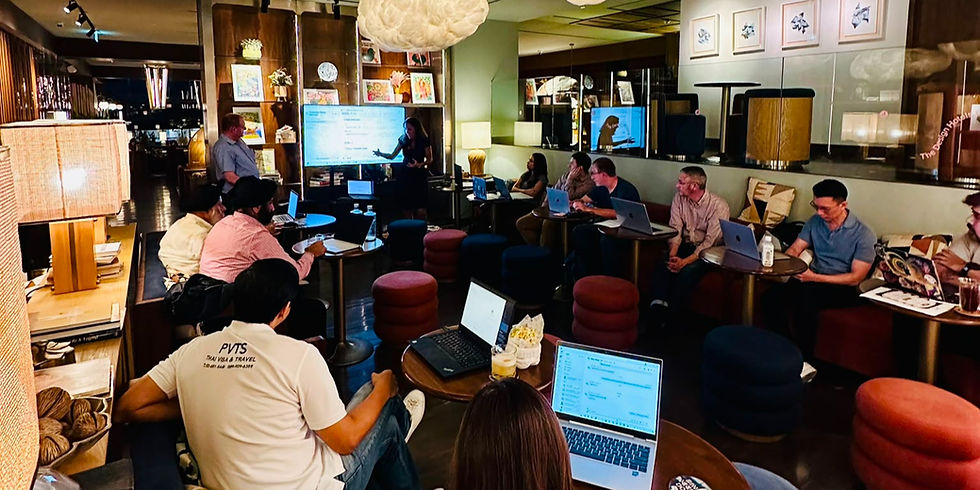
For La French Tech Bangkok, the international dimension of the report has particular relevance.
Thailand is part of a wider Southeast Asian business environment where digital transformation, AI adoption, industrial modernisation and sustainability are important areas of opportunity. French technology companies developing solutions in these fields may find potential customers, partners, and collaborators across the region.
At the same time, Thai companies and international businesses operating in Thailand can benefit from access to French expertise in software, AI, deeptech, healthcare, greentech, and industrial innovation.
Turning that potential into commercial results requires more than introductions. Companies need to understand local market conditions, identify genuine business needs, develop the right partnerships, and adapt their approach to the realities of operating in Southeast Asia.
This is one of the practical roles of an international French Tech community: helping companies build the relationships and local understanding needed to move from international ambition to market activity.
For startups considering Thailand, the country can be a starting point for exploring opportunities across Southeast Asia. For Thai businesses, engagement with French Tech can open doors to technologies, expertise, and potential partnerships from France.
The report's figures provide a strong foundation for these conversations. They demonstrate the scale of the French startup ecosystem, the breadth of its technological expertise, and the growing international ambitions of its companies.
Looking ahead: from innovation to global impact
The 2026 Overview of the French Tech Ecosystem describes an ecosystem that is becoming more mature, more internationally connected, greentech, and increasingly focused on scale.
Its 18,000 active startups and 450,000 direct jobs demonstrate its economic contribution. The €4.9 billion raised in the first half of 2026 reflects renewed momentum in fundraising, while the growth of AI, deeptech, robotics, quantum computing, space, greentech and healthcare highlights the breadth of French innovation.
The next challenge is to convert these capabilities into lasting commercial success: companies that can compete globally, technologies that reach the market, and partnerships that create value across industries and borders.
For founders, investors, and corporate leaders, the opportunities are not limited to France. They extend to the international markets, where French companies are building relationships, establishing operations, and finding new customers.
As part of a network spanning 57 countries, La French Tech Bangkok is proud to contribute to this international effort, connecting French innovation with Thailand's business community and helping create opportunities for collaboration.
French Tech's ambition is global. Its next chapter will be shaped not only by the technologies it develops but also by the partnerships it builds and the markets it reaches.
Source: French Tech - Panorama-2026 - 2026 Edition.
Download the full reports here:
French version:
English version:


Comments